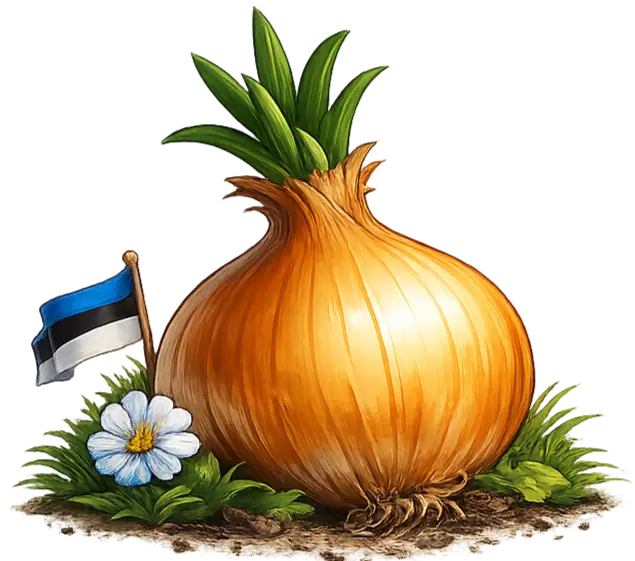
TALLINN — If you have found yourself on this page, you are either very curious, very confused, or you just read one of our articles and are no longer certain whether Estonia actually has a parliamentary committee dedicated to regulating sauna temperatures. (It doesn't. Probably.)
Welcome. Let us explain everything.
What Does Sibula Leht Mean?
Sibul is the Estonian word for onion. Leht is the Estonian word for page, leaf, or newspaper — as in ajaleht, the word for newspaper, which literally means "time page" or "time leaf." Together, Sibula Leht means "Onion Page" or, more elegantly, "Onion Newspaper."
This is, of course, a reference to The Onion — the American satirical publication that has been making people briefly believe fake headlines since 1988. We are The Onion, but for Estonia. Which is to say: colder, quieter, significantly more digitally advanced, and deeply concerned about the state of Tallinn tram punctuality.
Why an Onion?
The onion is, we would argue, the perfect metaphor for Estonia.
It has layers. Estonia has layers — the medieval Old Town visible from a modern glass office, the Soviet apartment blocks next to startup unicorns, the ancient song festival held in a country that invented digital voting. You think you understand Estonia and then you peel back another layer and find something unexpected. Possibly another layer.
It makes you cry, but in a productive way. Estonian directness, Estonian winters, and Estonian bureaucracy (even when digital) all share this quality.
It is fundamental to almost everything. You cannot make a proper soup without it. You cannot make sense of the Baltics without Estonia. The onion endures.
And it is, ultimately, a humble vegetable with an outsized influence. Estonia is a small country that has, against considerable odds, become one of the most technologically advanced nations on earth, invented Skype, and won the Eurovision Song Contest. The onion understands this energy.
Why Does Estonia Need Satire?
Estonia is a country where the government is entirely online, where you can start a company in fifteen minutes, and where the national response to almost any situation — joy, grief, victory, disaster — is to remain very still and say nothing for a moment before nodding once.
It is a country of 1.3 million people that genuinely considers itself a digital republic. Where e-Residency is a real thing you can have. Where the prime minister has a Twitter account and uses it. Where the entire healthcare system exists in an app.
And yet: the tram is sometimes late. Parking in Kalamaja is impossible. The sauna at the sports club is being renovated. The government website is down for maintenance. The queue at the Selver on a Saturday afternoon is, by any measure, a genuine crisis.
This is where we come in.
Who Is This For?
Sibula Leht is for everyone in Estonia — Estonians, expats, e-residents, tourists who got confused and stayed, and anyone who has ever had a deeply serious conversation about whether it is acceptable to use your phone in a sauna.
We write in English because Estonia's international community is enormous, because English is Estonia's second first language, and because our editor's Estonian, while improving, is not yet suitable for professional comedy writing.
Is Any of This Real?
No. Everything on Sibula Leht is satirical. All characters are fictional. All events are invented. All statistics were made up in a Kalamaja cafe. If something we publish sounds exactly like something that would happen in Estonia, that is not because we have inside information. That is because Estonia is, bless it, extremely easy to satirise.
Common Estonian Expressions You May Encounter in Our Articles
Noh — A versatile filler word meaning approximately "well," "so," "right then," or "I have acknowledged your existence and am now processing." The Estonian equivalent of "mela."
Jah — Yes. Said once, firmly, with eye contact. Means yes.
Ei — No. Said once, firmly, with slightly less eye contact. Means no. Often the final word.
Tere — Hello. Deployed efficiently, without excessive warmth, which is warmth by Estonian standards.
Aitäh — Thank you. Said with genuine feeling. Estonians mean it when they say it, precisely because they don't say it unnecessarily.
Head aega — Goodbye. Literally "good time." A nice thing to say. We say it to you now.
Why Sibula Leht Exists
Because every country deserves someone pointing at it, affectionately, and saying: this is absurd, and we love it, and isn't it something that you can file your taxes in two minutes while sitting in a sauna that is technically a UNESCO cultural heritage practice.
Estonia is magnificent. We are here to celebrate that magnificence by making fun of it, gently, in English, with Playfair Display headlines and a cream-coloured background that we call "newsprint" because we are very committed to the bit.
Head aega. Come back tomorrow. There will be new things to point at.